Adding Web3 to Your Business: Enterprise Tech Guide
Learn how to seamlessly integrate Web3 capabilities—including tokenomics, smart contracts, decentralized identity, and wallet authentication—into your existing business architecture.

TL;DR: Adding Web3 to your business enables decentralized identity, tokenized customer loyalty, micro-settlements, and trustless data verification alongside your existing web infrastructure. By integrating wallet authentication, smart contracts, and decentralized storage gradually through hybrid Web2/Web3 architectures, enterprises can unlock new revenue streams without compromising user experience or security. LaunchLive Studio builds production-ready Web3 integrations tailored to your business model.
What Is Web3 Business Integration?
Web3 business integration is the process of embedding decentralized technologies—such as blockchain networks, smart contracts, cryptographic wallet authentication, and peer-to-peer storage—into traditional Web2 business operations and digital products.
Unlike purely speculative crypto applications, Web3 enterprise integration focuses on utility: replacing centralized databases for cross-organization trust, enabling instant cross-border micropayments, issuing verifiable credentials, and establishing direct digital ownership for customers.
Why Web3 Matters for Modern Businesses
Integrating Web3 features transforms how businesses build customer trust, capture value, and reduce operational friction. In traditional Web2 models, companies act as centralized gatekeepers of user data and payment pipelines, incurring heavy processing fees, platform risk, and database compliance overhead.
Web3 shifts this paradigm by enabling programmable trust:
- Zero-Friction Identity & Onboarding: Passwordless wallet sign-in (Sign-In with Ethereum / EVM) eliminates account creation friction while giving users control over their data identity.
- Programmable Loyalty & Tokenization: Tokenized loyalty points or digital collectibles (NFTs) create liquid, interoperable rewards that customers can trade or redeem across partner ecosystems.
- Automated Settlement via Smart Contracts: Self-executing code automates complex escrow, revenue sharing, and royalty payouts without intermediary processing delays or fees.
- Verifiable Data Provenance: Immutable ledger records ensure supply chain traceability and verifiable audit trails for regulated operations.
Web2 vs. Hybrid Web3 Enterprise Architecture
| Feature | Traditional Web2 Architecture | Hybrid Web3 Architecture |
|---|---|---|
| Authentication | OAuth / Email & Password | Wallet Signature (SIWE) + JWT / OAuth Hybrid |
| Data Storage | Centralized SQL / NoSQL (PostgreSQL, MongoDB) | Relational Database + IPFS / Arweave for Media |
| Payments & Billing | Stripe, PayPal, Credit Card Processors | Fiat Gateways + On-Chain Crypto / Stablecoin Settlements |
| Business Logic | Server-side APIs (Node.js, Go, Python) | Microservices + On-Chain Smart Contracts (Solidity, Rust) |
| State Management | Redux / Zustand / Server State | React Query / Wagmi / Viem Web3 Providers |
How to Add Web3 to Your Business: 4 Core Pillars
Successfully introducing Web3 to an existing digital product requires a phased, hybrid approach rather than an all-at-once migration.
1. Cryptographic Wallet Authentication (SIWE)
The simplest entry point is replacing or supplementing traditional logins with Sign-In with Ethereum (SIWE) or multi-chain wallet connectors (RainbowKit, ConnectKit, Privy). The user signs a cryptographic nonce with their private key, proving identity without sharing sensitive personal identifiers.
2. Smart Contract Business Logic
Encapsulate key business rules—such as escrow logic, membership checks, or conditional payouts—into audited smart contracts deployed on Ethereum, Polygon, Arbitrum, or Solana. Use battle-tested contract standards like ERC-20 (fungible tokens), ERC-721/ERC-1155 (digital assets), or Account Abstraction (ERC-4337) to eliminate gas fee friction for non-technical users.
3. Web3 State Integration & Frontend Patterns
In modern frontend frameworks like Next.js, Web3 interactions must handle asynchronous network state smoothly. Use wagmi and viem for RPC calls, manage optimistic updates with Zustand or TanStack Query, and wrap Web3 components in robust React Error Boundaries to handle RPC rate limits or wallet user rejections gracefully.
4. Decentralized Storage & Indexing
Store heavy assets (images, documents, metadata) on IPFS or Arweave, storing only the content hash on-chain. Query on-chain events efficiently using subgraphs (The Graph) or custom indexing pipelines rather than querying raw RPC nodes directly in frontend components.
Practical Steps to Integrate Web3 Into Your Stack
To safely roll out Web3 functionality without disrupting existing users:
- Define a Clear Utility Goal: Identify whether you are solving for payment efficiency, customer retention, or supply chain transparency before picking a blockchain protocol.
- Select a Scalable Layer-2 Network: Choose low-cost, high-throughput EVM chains or Layer-2 rollups (Polygon, Arbitrum, Base) to keep transaction fees near zero for your users.
- Implement Account Abstraction (ERC-4337): Allow users to sign in with email or social accounts while sponsoring their gas fees behind the scenes for an invisible Web3 UX.
- Audit All Smart Contracts: Conduct rigorous automated security scanning and third-party security audits before deploying any smart contracts to mainnet.
- Build a Hybrid Indexing Layer: Sync on-chain events into your primary database (e.g., PostgreSQL) so your search, analytics, and admin dashboards load instantly.
Common Mistakes When Adding Web3 to Your Business
Many teams rush into Web3 without considering long-term UX and operational hurdles:
- Forcing Crypto Jargon on Users: Requiring non-crypto-native users to manage seed phrases or buy native gas tokens kills conversion rates. Abstract Web3 complexity behind intuitive UI components.
- Storing Personal Data On-Chain: Storing PII (Personally Identifiable Information) directly on an immutable public ledger violates GDPR right-to-be-forgotten regulations.
- Over-Engineering Smart Contracts: Putting business logic on-chain when a standard API would suffice increases gas costs and makes system updates unnecessarily complex.
- Neglecting RPC Provider Redundancy: Relying on a single public RPC node leads to downtime during network spikes. Use redundant RPC providers (Alchemy, Infura, QuickNode) with fallback mechanisms.
FAQ
Q: What is the fastest way to add Web3 login to an existing app? A: Use an authentication SDK like Privy or RainbowKit alongside Sign-In with Ethereum (SIWE). These tools allow users to sign in with non-custodial wallets or social logins seamlessly while issuing standard JWT tokens for your backend.
Q: Do my customers need to own cryptocurrency to use my Web3 features? A: No. By leveraging Account Abstraction (ERC-4337) and paymasters, your application can sponsor transaction gas fees, allowing users to interact with Web3 features using email sign-in and credit card fiat gateways.
Q: How does Web3 integration impact GDPR compliance? A: Web3 features must not store PII on public blockchains. Store personal data off-chain in encrypted Web2 databases, using on-chain smart contracts only for cryptographic hashes, token balances, and non-sensitive state.
Q: Which blockchain network is best for business applications? A: EVM-compatible Layer-2 networks like Base, Arbitrum, or Polygon are ideal for business applications due to near-instant finality, sub-cent transaction fees, strong developer tooling, and enterprise adoption.
Q: How long does it take to build a Web3 MVP? A: A hybrid Web3 MVP featuring wallet auth, custom smart contracts, and a Next.js frontend typically takes 4 to 8 weeks when using modular SDKs and established development frameworks.
Conclusion: Partner with LaunchLive Studio for Your Web3 Transformation
Web3 technology is no longer an experimental sandbox—it is a powerful layer for customer retention, automated settlement, and digital ownership. By adopting a pragmatic hybrid architecture, your business can harness decentralized technology today while delivering the seamless user experience your customers demand.
Ready to explore Web3 for your enterprise? Explore our Selected Work or partner with experts to design and deploy your custom solution.
Enjoyed this insight
on Web3 & Blockchain?
"At Launch Live Studio, we help ambitious brands implement these exact systems to drive scalable revenue."
FREE 30-MINUTE STRATEGY CONSULTATION • CLEAR ANSWERS ON OUR FAQ
Related Growth Guides.

UI/UX Design & Product Strategy
Explaining Complex Tech Simply: How Good Visuals and Stories Win Buyer Trust
A comprehensive guide for tech brands on using visual storytelling and progressive disclosure UI to simplify complex products, bridge the buyer trust gap, and accelerate B2B enterprise sales cycles.

UI/UX Design & Product Strategy
Clear App Navigation: How Simple Menus Prevent SaaS Churn
A practical guide to designing intuitive SaaS navigation menus. Learn how clear visual hierarchy, simple menu architecture, and friction-free user flows reduce cognitive load, increase session duration, and prevent client churn.
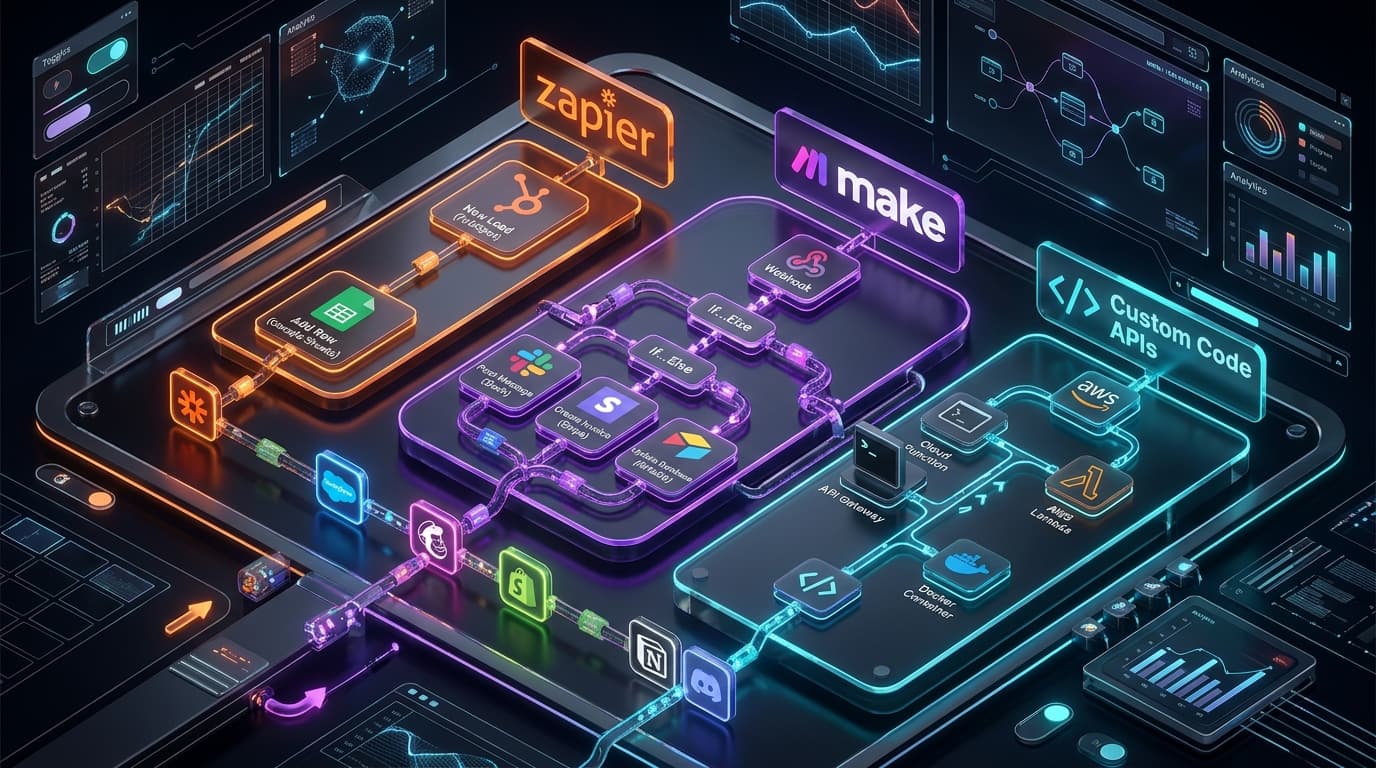
Workflow Automation & Systems Integration
Zapier vs Make vs Custom Code: Best Automation Guide
An honest, practical guide comparing Zapier, Make (Integromat), and Custom Code APIs for modern businesses. Discover when to use no-code tools for fast marketing automations, when to use Make for complex multi-step data routing, and when custom serverless microservices save thousands in platform subscription fees.