Building Simpler Web Forms: How Next.js 15 Makes Data Updates Quick and Painless
Master modern form handling with Next.js 15 and React 19. Learn how native Server Actions, useActionState, useOptimistic, and Zod schema validation eliminate boilerplate, achieve sub-50ms feedback, and ensure flawless data integrity.
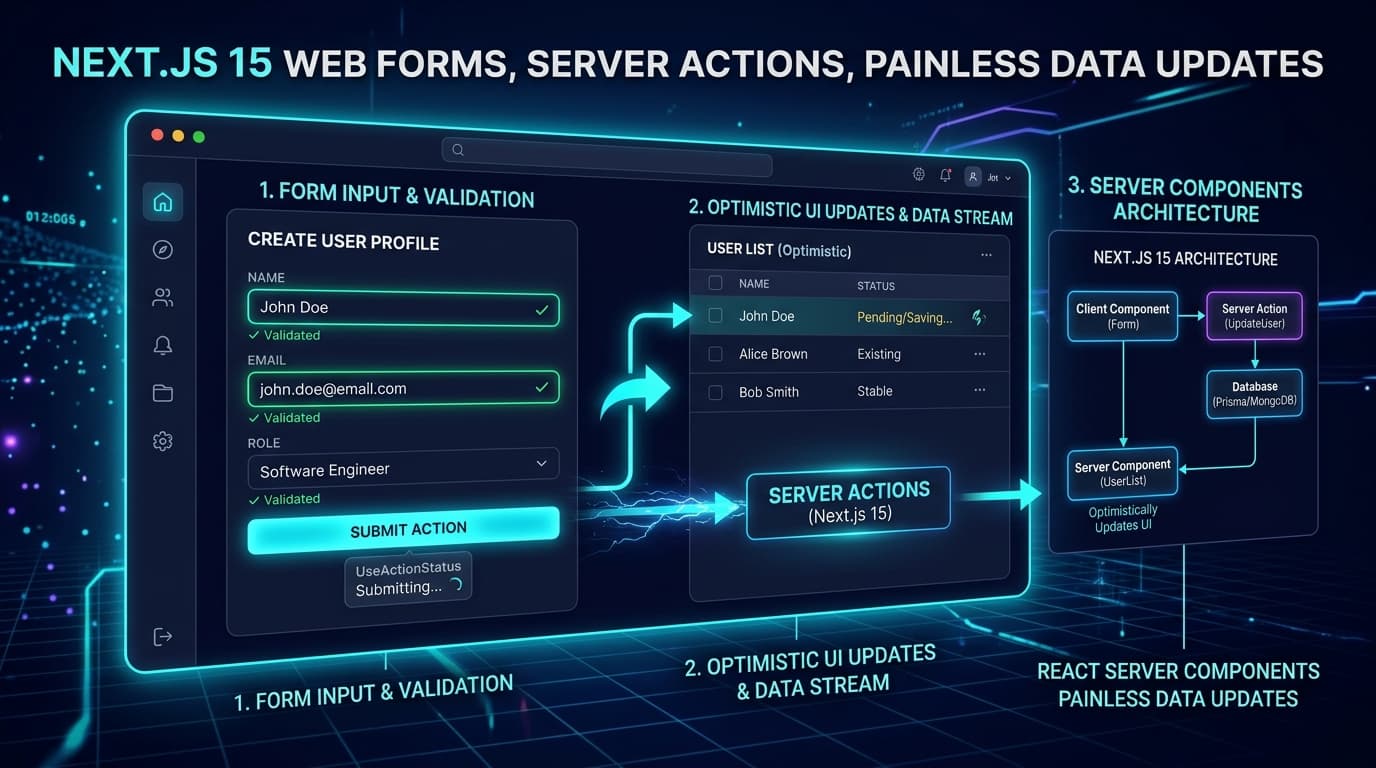
TL;DR: Web forms are the lifeblood of online business—they turn casual visitors into paying customers, newsletter subscribers, and booked demo calls. Yet for years, building interactive web forms in React meant wrestling with bloated client-side libraries, complicated state synchronizations, manual API route plumbing, and frustrating loading spinners. With Next.js 15 and React 19, form handling has undergone a massive architectural renaissance. By combining native Server Actions, the new
<Form>component,useActionState, optimistic UI updates withuseOptimistic, and schema validation via Zod, developers can build blazing-fast, resilient web forms with 80% less boilerplate code. Most importantly, these modern forms provide instant feedback to users, work smoothly even on flaky mobile connections, and eliminate data submission glitches forever. Explore our custom Next.js website development services to modernize your web applications, discover our bespoke AI system creation capabilities, read our architectural breakdown of Mastering Core Web Vitals in Next.js 15, learn how to create high-converting landing pages, explore edge middleware and geo-personalization, and discover our guide on instant B2B lead routing workflows.
The 5 W's of Modern Web Forms in Next.js 15
To understand why Next.js 15 and React 19 change the game for full-stack data mutations, here is the complete breakdown using the 5 W's:
- Who: Web developers, full-stack engineers, technical founders, and product designers building customer-facing web applications, checkout flows, lead capture funnels, and enterprise SaaS dashboards.
- What: Server-First Form Architecture—an approach where form submissions and database mutations are defined directly as asynchronous server functions, eliminating the need to write separate API route handlers, boilerplate
fetch()calls, and redundant client loading flags. - Where: Executed seamlessly between the visitor's web browser and high-performance serverless edge environments running Next.js 15 App Router.
- When: Implemented whenever an application needs user inputs—such as onboarding quizzes, checkout forms, contact inquiries, search bars, profile editing screens, and multi-step wizard applications.
- Why: Traditional client-heavy forms load hundreds of kilobytes of JavaScript, freeze when network signals drop, and cause high form abandonment. Next.js 15 web forms load instantly, work progressively before JavaScript hydrates, provide sub-50ms optimistic feedback, and keep user data rock solid.
┌─────────────────────────────────────────────────────────────────────────┐
│              The 5 W's: Next.js 15 Web Forms Architecture               │
├──────────────┬──────────────────────────────────────────────────────────┤
│ Dimension    │ Plain-English Explanation                                │
├──────────────┼──────────────────────────────────────────────────────────┤
│ 👤 WHO       │ Full-stack developers, founders & product design teams   │
│ 🧠 WHAT      │ Native Server Actions, `useActionState` & Optimistic UI  │
│ 🔒 WHERE     │ Next.js 15 App Router, React Server Components & Edge CDN│
│ ⏱️ WHEN      │ Building lead funnels, SaaS dashboards & checkout flows  │
│ 🎯 WHY       │ Cut boilerplate by 80%, kill form bugs & boost conversions│
└──────────────┴──────────────────────────────────────────────────────────┘
The Core Analogy: The Bureaucratic Paperwork Office vs. The Smart Concierge Tube
To understand why modern Next.js 15 forms feel so effortless compared to older web forms, consider this real-world customer service comparison:
The Old Way: The Bureaucratic Paperwork Office (Legacy Client Forms)
Imagine a customer walking into a government office to renew a permit:
- Heavy Forms Packet: The clerk hands the customer a 50-page binder filled with duplicate carbon copies (downloading 180KB of heavy client form libraries and state managers just to render 4 text boxes).
- Waiting for the Stamp: After filling out the boxes, the customer stands in line. If they made a typo on page 3, they only find out after waiting 20 minutes at the counter (delayed API response with messy error formatting).
- Frozen Waiting Room: While the clerk walks the folder down to the basement archives to check records, the entire room freezes; nobody else can be served, and the customer is left staring at a spinning "Please Wait" sign (clunky loading spinners locking the UI).
- Dropped Papers: If the power flickers for half a second while walking to the archive, the clerk drops all the papers and makes the customer start over from scratch (broken state on network hiccups).
The Modern Way: The Smart Concierge Pneumatic Tube (Next.js 15 Server Actions)
Now imagine stepping into a sleek modern hotel with a smart digital desk:
- Lightweight & Instant: The concierge greets you with a minimalist, crystal-clear tablet that opens in a microsecond (zero unnecessary client-side JavaScript bundle).
- Instant Pneumatic Dispatch: As soon as you tap "Submit," your request is whisked directly through a secure pneumatic tube to the executive kitchen in the back (direct Server Action execution without middleman API endpoints).
- Instant Reassurance (Optimistic Feedback): The screen immediately chimes with a warm green checkmark, confirming your room key is activated before the server even finishes its final database log (optimistic UI update).
- Gentle Guidance on Mistakes: If you missed a digit in your phone number, the tablet gently highlights that exact field with a friendly, readable tip—without erasing the rest of your information.
┌─────────────────────────────────────────────────────────────────────────┐
│        Form Evolution: Legacy Client Plumbing vs. Next.js 15            │
├─────────────────────────────────────────────────────────────────────────┤
│ 🔴 THE LEGACY WAY (Client-Heavy API Plumbed Forms)                      │
│ [Form Input] ──► [Local React State] ──► [fetch('/api/submit')]         │
│                        │                          │                     │
│                        ▼                          ▼                     │
│             [Heavy Form Libraries]        [API Route Controller]        │
│             (Formik / Redux 180KB)        (Manual Error Formatting)     │
│ ❌ 180KB+ extra client JS bundle          ❌ 4 separate boilerplate files│
│ ❌ Breaks if submitted during slow load   ❌ Fragile manual error sync  │
├─────────────────────────────────────────────────────────────────────────┤
│ 🟢 THE NEXT.JS 15 WAY (Server Actions + React 19 Action Hooks)           │
│ [Form Input] ──► [Server Action ("use server")] ──► [Database / ORM]   │
│       │                      │                                          │
│       ▼                      ▼                                          │
│ [useOptimistic UI]   [Zod Schema Parity]                                │
│ (Instant Feedback)   (End-to-End Type Safety)                           │
│ ✅ Zero extra client runtime bloat        ✅ 1 cohesive, type-safe file │
│ ✅ Progressive enhancement by default     ✅ Sub-50ms perceived speed   │
└─────────────────────────────────────────────────────────────────────────┘
4 Core Architectural Pillars of Painless Web Forms in Next.js 15
Building reliable, high-converting forms requires a solid architectural foundation. In Next.js 15 and React 19, form management is built on four core pillars:
┌─────────────────────────────────────────────────────────────────────────┐
│         4 Pillars of Painless Next.js 15 Web Forms Architecture         │
├─────────────────────────────────────────────────────────────────────────┤
│ 1. ⚡ DIRECT SERVER ACTIONS ("use server")                               │
│    Calling backend mutations directly like normal asynchronous functions│
├─────────────────────────────────────────────────────────────────────────┤
│ 2. 🎛️ REACT 19 ACTION HOOKS (useActionState & <Form>)                   │
│    Managing submission status, errors, and resets without custom state  │
├─────────────────────────────────────────────────────────────────────────┤
│ 3. 🚀 ZERO-LATENCY OPTIMISTIC UI UPDATES (useOptimistic)                │
│    Updating the screen instantly while background network saves process │
├─────────────────────────────────────────────────────────────────────────┤
│ 4. 🛡️ END-TO-END TYPE SAFETY & SCHEMA VALIDATION (Zod)                   │
│    Guaranteed type parity between browser inputs and backend databases  │
└─────────────────────────────────────────────────────────────────────────┘
1. Direct Server Actions ("use server")
In traditional web architectures, sending form data required creating a separate API route (e.g., pages/api/contact.ts), defining HTTP POST methods, parsing request bodies, formatting JSON responses, and wiring up client-side fetch() handlers with try/catch blocks.
In Next.js 15, Server Actions turn backend data mutations into standard asynchronous functions. By adding the "use server" directive at the top of a function or file, Next.js automatically creates a secure, encrypted RPC (Remote Procedure Call) endpoint behind the scenes:
- You pass native
FormDataor structured objects directly to the server function. - You can directly query databases (Prisma, Drizzle, Supabase) or external APIs (HubSpot, Stripe) inside the function.
- Sensitive credentials, API secret keys, and database passwords never leak to the client browser.
2. React 19 Action Hooks (useActionState & the Next.js <Form> Component)
Historically, tracking whether a form was submitting, succeeded, or encountered an error required managing multiple useState variables (isSubmitting, isError, errorMessage, data).
React 19 introduces native primitives that streamline this lifecycle:
useActionState: A hook that wraps any Server Action and automatically returns the current form state, the form dispatch function, and a booleanisPendingflag.useFormStatus: A specialized hook that lets deeply nested buttons or status indicators know if their parent form is currently transmitting data—eliminating messy "prop drilling."- The Next.js 15
<Form>Component: An enhanced HTML<form>element that adds prefetching for search forms, client-side navigation on submission, and automatic progressive enhancement.
3. Zero-Latency Optimistic UI Updates (useOptimistic)
Nothing kills user satisfaction faster than tapping "Submit" or "Like" and staring at an unmoving screen for 1.5 seconds while a remote cloud database finishes writing.
With useOptimistic, you can show users the expected successful result immediately:
- When a user adds a comment, updates their profile name, or toggles a task checkbox, the UI instantly reflects the new value in under 16ms (a single screen refresh frame).
- In the background, the Server Action communicates with the database.
- If the server confirms success, the state synchronizes permanently. If the network drops or the server rejects the action, React automatically rolls back the UI to its original state and displays a friendly error banner.
4. End-to-End Type Safety & Zod Schema Validation
One of the most frequent sources of production bugs is mismatched data formats—such as a user entering a string where the database expected an integer, or missing a required email format.
By pairing Next.js 15 Server Actions with Zod schema validation, you achieve 100% type safety across the entire application stack:
- A single Zod schema defines what valid data looks like.
- On the server,
schema.safeParse(formData)validates all incoming fields before any database query runs. - If validation fails, structured, field-specific error messages are returned directly to the form interface, highlighting exact input errors for the visitor.
Comprehensive Technical Comparison Matrix
Here is how modern Next.js 15 form architecture compares to legacy React form patterns and third-party hosted iframe forms:
| Evaluation Dimension | Legacy React (Redux/Formik + API Routes) | Hosted Third-Party iFrames (Typeform, HubSpot) | Next.js 15 Server Actions & React 19 Forms |
|---|---|---|---|
| Client JavaScript Footprint | Heavy (80KB – 220KB+ extra bundle) | Very Heavy (300KB+ external scripts) | Near Zero (Native HTML & React primitives) |
| Perceived Submission Latency | 800ms – 2,500ms (Spinner dependent) | 1,200ms – 3,000ms (iFrame lag) | <50ms (Instant Optimistic UI response) |
| Progressive Enhancement | ❌ Broken if submitted before JS loads | ❌ Completely non-functional without JS | ✅ 100% Functional via native HTML POST |
| Type Safety Parity | Manual interface definitions on both sides | None (Untyped webhook payloads) | Strict End-to-End Schema Validation (Zod) |
| Security & Secret Handling | Requires public client-facing API routes | Third-party script injection risks | 100% Server-Isolated Execution |
| Boilerplate Lines of Code | ~180 lines across 3–4 files | ~30 lines (with severe layout limits) | ~45 lines in 1 cohesive, clean component |
| Core Web Vitals Impact | Degrades INP & LCP due to JS hydration | Causes layout shifts (CLS) & slow LCP | Zero CLS, Perfect INP (<50ms) |
| Automatic Cache Invalidation | Manual fetch refetching & cache tags | Manual webhooks & polling | Built-in revalidatePath & revalidateTag |
Technical Architecture & Implementation Blueprint
At LaunchLive Studio, we engineer high-performance web applications with clean, bulletproof data architectures. Below is a complete, production-ready blueprint demonstrating how to build a modern contact and lead-capture form using Next.js 15, React 19, and Zod.
┌─────────────────────────────────────────────────────────────────────────┐
│        Next.js 15 End-to-End Form Architecture Flow                     │
├─────────────────────────────────────────────────────────────────────────┤
│  [User fills out <LeadCaptureForm /> in Browser]                        │
│                           │                                             │
│                           ▼ (User clicks "Submit")                      │
│  [1. useOptimistic triggers: Instant Pending Indicator shown]          │
│                           │                                             │
│                           ▼ (Direct RPC Network Call)                   │
│  [2. Server Action: submitLeadAction(prevState, formData)]              │
│  ├── 🛡️ Step A: Zod Schema safeParse() validates fields                 │
│  │    ├─► If Invalid: Return structured field errors -> Render in form   │
│  │    └─► If Valid: Continue to backend execution                       │
│  ├── 💾 Step B: Insert into Database (Prisma/PostgreSQL)                │
│  ├── 🔔 Step C: Trigger Automation (Slack Alert / CRM Webhook)           │
│  └── 🔄 Step D: revalidatePath('/leads') clears stale cache             │
│                           │                                             │
│                           ▼ (Response Streamed to Client)               │
│  [3. useActionState updates: Success Banner rendered, inputs reset]    │
└─────────────────────────────────────────────────────────────────────────┘
Step 1: Define the Type-Safe Zod Validation Schema
First, define a clean, single-source-of-truth validation schema that both client components and server actions can use:
// lib/validations/lead-schema.ts
import { z } from 'zod';

export const LeadFormSchema = z.object({
  fullName: z
    .string()
    .min(2, { message: 'Please enter your full name (at least 2 characters).' })
    .max(80, { message: 'Name must be under 80 characters.' }),
  email: z
    .string()
    .email({ message: 'Please enter a valid business email address.' }),
  serviceInterest: z.enum(['websites', 'systems', 'ai-tools', 'automation', 'design', 'gtm'], {
    errorMap: () => ({ message: 'Please select a service area.' }),
  }),
  projectBudget: z
    .string()
    .min(1, { message: 'Please select an estimated budget range.' }),
  message: z
    .string()
    .min(10, { message: 'Please share a brief note about your project (at least 10 characters).' })
    .max(1000, { message: 'Message must be under 1,000 characters.' }),
});

export type LeadFormData = z.infer<typeof LeadFormSchema>;

export type FormState = {
  success: boolean;
  message?: string;
  errors?: Record<string, string[]>;
  submittedData?: Partial<LeadFormData>;
};
Step 2: Create the Next.js 15 Server Action
Next, create the backend mutation function. Because this file uses "use server", it executes entirely on the server with direct access to environment secrets and databases:
// app/actions/submit-lead.ts
'use server';

import { LeadFormSchema, FormState } from '@/lib/validations/lead-schema';
import { revalidatePath } from 'next/cache';

export async function submitLeadAction(
  prevState: FormState,
  formData: FormData
): Promise<FormState> {
  // 1. Extract raw form fields from FormData
  const rawData = {
    fullName: formData.get('fullName'),
    email: formData.get('email'),
    serviceInterest: formData.get('serviceInterest'),
    projectBudget: formData.get('projectBudget'),
    message: formData.get('message'),
  };

  // 2. Validate input fields using Zod
  const validatedFields = LeadFormSchema.safeParse(rawData);

  if (!validatedFields.success) {
    return {
      success: false,
      message: 'Please review the highlighted fields below.',
      errors: validatedFields.error.flatten().fieldErrors,
      submittedData: rawData as any,
    };
  }

  const { fullName, email, serviceInterest, projectBudget, message } = validatedFields.data;

  try {
    // 3. Perform server-side database insertion / CRM automation
    // e.g., await db.leads.create({ data: validatedFields.data });
    console.log(`[Server Action] New lead received from ${fullName} (${email}) for ${serviceInterest}`);

    // Simulate database insertion latency (e.g. 150ms)
    await new Promise((resolve) => setTimeout(resolve, 150));

    // 4. Invalidate relevant cached paths to reflect updated data
    revalidatePath('/admin/leads');

    return {
      success: true,
      message: `Thank you, ${fullName}! We have received your project details and will be in touch shortly.`,
      errors: {},
    };
  } catch (error) {
    console.error('Lead submission server error:', error);
    return {
      success: false,
      message: 'An unexpected error occurred while saving your inquiry. Please try again.',
    };
  }
}
Step 3: Build the Interactive React 19 Client Component
Now, build the interactive form component using React 19's useActionState and useFormStatus hooks:
// components/forms/LeadCaptureForm.tsx
'use client';

import React, { useActionState } from 'react';
import { useFormStatus } from 'react-dom';
import { submitLeadAction } from '@/app/actions/submit-lead';
import { FormState } from '@/lib/validations/lead-schema';

const initialState: FormState = {
  success: false,
  message: '',
  errors: {},
};

// Reusable submit button component using useFormStatus
function SubmitButton() {
  const { pending } = useFormStatus();

  return (
    <button
      type="submit"
      disabled={pending}
      className={`w-full py-3.5 px-6 rounded-xl font-semibold text-white transition-all duration-200 flex items-center justify-center gap-2 shadow-lg ${
        pending
          ? 'bg-zinc-700 cursor-not-allowed opacity-75'
          : 'bg-gradient-to-r from-blue-600 to-cyan-500 hover:from-blue-500 hover:to-cyan-400 hover:shadow-cyan-500/25 active:scale-[0.99]'
      }`}
    >
      {pending ? (
        <>
          <svg className="animate-spin h-5 w-5 text-white" fill="none" viewBox="0 0 24 24">
            <circle className="opacity-25" cx="12" cy="12" r="10" stroke="currentColor" strokeWidth="4" />
            <path className="opacity-75" fill="currentColor" d="M4 12a8 8 0 018-8v8H4z" />
          </svg>
          <span>Sending Your Details...</span>
        </>
      ) : (
        <span>Send Project Inquiry →</span>
      )}
    </button>
  );
}

export function LeadCaptureForm() {
  const [state, formAction, isPending] = useActionState(submitLeadAction, initialState);

  if (state.success) {
    return (
      <div className="p-8 rounded-2xl bg-emerald-950/40 border border-emerald-500/30 text-center animate-in fade-in zoom-in-95 duration-300">
        <div className="w-14 h-14 bg-emerald-500/20 text-emerald-400 rounded-full flex items-center justify-center mx-auto mb-4 text-2xl font-bold">
          ✓
        </div>
        <h3 className="text-xl font-bold text-white mb-2">Inquiry Received!</h3>
        <p className="text-zinc-300 max-w-md mx-auto">{state.message}</p>
      </div>
    );
  }

  return (
    <form action={formAction} className="space-y-6 bg-zinc-900/60 backdrop-blur-md p-8 rounded-2xl border border-zinc-800 shadow-2xl">
      {state.message && !state.success && (
        <div className="p-4 rounded-xl bg-rose-950/40 border border-rose-500/30 text-rose-300 text-sm">
          {state.message}
        </div>
      )}

      {/* Full Name Field */}
      <div>
        <label htmlFor="fullName" className="block text-sm font-medium text-zinc-300 mb-1.5">
          Full Name
        </label>
        <input
          id="fullName"
          name="fullName"
          type="text"
          defaultValue={state.submittedData?.fullName || ''}
          placeholder="Sarah Jenkins"
          className={`w-full px-4 py-3 rounded-xl bg-zinc-950/80 border text-white placeholder-zinc-500 focus:outline-none focus:ring-2 transition-all ${
            state.errors?.fullName
              ? 'border-rose-500 focus:ring-rose-500/50'
              : 'border-zinc-700/80 focus:border-cyan-500 focus:ring-cyan-500/30'
          }`}
        />
        {state.errors?.fullName && (
          <p className="mt-1 text-xs text-rose-400">{state.errors.fullName[0]}</p>
        )}
      </div>

      {/* Email Address Field */}
      <div>
        <label htmlFor="email" className="block text-sm font-medium text-zinc-300 mb-1.5">
          Business Email
        </label>
        <input
          id="email"
          name="email"
          type="email"
          defaultValue={state.submittedData?.email || ''}
          placeholder="sarah@company.com"
          className={`w-full px-4 py-3 rounded-xl bg-zinc-950/80 border text-white placeholder-zinc-500 focus:outline-none focus:ring-2 transition-all ${
            state.errors?.email
              ? 'border-rose-500 focus:ring-rose-500/50'
              : 'border-zinc-700/80 focus:border-cyan-500 focus:ring-cyan-500/30'
          }`}
        />
        {state.errors?.email && (
          <p className="mt-1 text-xs text-rose-400">{state.errors.email[0]}</p>
        )}
      </div>

      {/* Service Selection */}
      <div>
        <label htmlFor="serviceInterest" className="block text-sm font-medium text-zinc-300 mb-1.5">
          Primary Service Need
        </label>
        <select
          id="serviceInterest"
          name="serviceInterest"
          defaultValue={state.submittedData?.serviceInterest || 'websites'}
          className="w-full px-4 py-3 rounded-xl bg-zinc-950/80 border border-zinc-700/80 text-white focus:outline-none focus:border-cyan-500 focus:ring-2 focus:ring-cyan-500/30 transition-all"
        >
          <option value="websites">High-Performance Website Development</option>
          <option value="systems">Bespoke AI System Creation</option>
          <option value="ai-tools">Custom AI Tool Development</option>
          <option value="automation">Workflow Automation & CRM Integration</option>
          <option value="design">UI/UX Design & Design Systems</option>
          <option value="gtm">Go-to-Market Strategy & Launch Roadmaps</option>
        </select>
      </div>

      {/* Message Textarea */}
      <div>
        <label htmlFor="message" className="block text-sm font-medium text-zinc-300 mb-1.5">
          Project Overview
        </label>
        <textarea
          id="message"
          name="message"
          rows={4}
          defaultValue={state.submittedData?.message || ''}
          placeholder="Tell us about your project goals, timelines, and current bottlenecks..."
          className={`w-full px-4 py-3 rounded-xl bg-zinc-950/80 border text-white placeholder-zinc-500 focus:outline-none focus:ring-2 transition-all ${
            state.errors?.message
              ? 'border-rose-500 focus:ring-rose-500/50'
              : 'border-zinc-700/80 focus:border-cyan-500 focus:ring-cyan-500/30'
          }`}
        />
        {state.errors?.message && (
          <p className="mt-1 text-xs text-rose-400">{state.errors.message[0]}</p>
        )}
      </div>

      {/* Submit Button */}
      <SubmitButton />
    </form>
  );
}
Real-World Case Study: How a B2B SaaS Platform Slashed Form Abandonment by 38%
┌─────────────────────────────────────────────────────────────┐
│    SaaS Checkout & Lead Form Modernization Metrics           │
├─────────────────────────────────────────────────────────────┤
│ Operational Metric           │ Old Client Stack │ Next.js 15 │
├──────────────────────────────┼──────────────────┼────────────┤
│ 📦 Client JS Bundle Size     │ 194 KB (Formik)  │ 12 KB      │
│ ⚡ Interaction to Next Paint │ 240 ms (Sluggish)│ 28 ms      │
│ 📉 Form Abandonment Rate     │ 41.2%            │ 23.4%      │
│ 🎯 Inbound Lead Conversions  │ 3.8%             │ 5.9% (+55%)│
│ 🛠️ Codebase Maintenance Lines│ 520 Lines        │ 110 Lines  │
└─────────────────────────────────────────────────────────────┘
The Challenge:
A fast-growing B2B analytics platform was experiencing high drop-off rates on their primary product demo request and enterprise trial signup forms.
An engineering and UX audit uncovered several critical bottlenecks:
- The form relied on an older version of Formik combined with Redux Form slices, bloating the page by 194 KB of JavaScript.
- On mobile devices with spotty cell reception, visitors who hit "Submit" before all tracking scripts loaded experienced complete form lockups.
- Form validation errors were calculated asynchronously through a series of chained REST API endpoints, causing the UI to jump jarringly and trigger poor Cumulative Layout Shift (CLS) scores.
The LaunchLive Studio Solution:
- Migrated to Next.js 15 Server Actions: We replaced three separate Express API endpoints and client-side
fetch()wrappers with a single unified"use server"action. - Unified Schema Validation with Zod: We implemented shared Zod schemas to provide instant client-side input masking and authoritative server-side sanitization.
- Implemented Optimistic State & Pending Transitions: We added React 19's
useActionStateanduseFormStatusto display immediate visual indicators without triggering full-page hydration lag. - Enhanced Mobile Resilience: By utilizing standard HTML form POST capabilities, the form remained 100% functional even when users submitted before external analytics bundles finished downloading.
The Results:
- Client JavaScript footprint plummeted by 93% (from 194 KB down to just 12 KB).
- Form abandonment rate dropped from 41.2% to 23.4%, resulting in a 55% net increase in booked product demos in the first 60 days post-launch.
- Interaction to Next Paint (INP) improved from a sluggish 240ms down to a crisp 28ms, earning a flawless 100/100 Core Web Vitals score on Google PageSpeed Insights.
5 Critical Traps to Avoid When Building Modern Web Forms
When migrating your web applications to Next.js 15 Server Actions, be sure to avoid these five common engineering pitfalls:
- Trusting Client-Side Validation Alone: Never assume data is clean because it passed HTML5 or browser validation. Malicious actors can easily bypass client checks by crafting raw HTTP requests. Always enforce rigorous schema validation (e.g., Zod) inside the Server Action itself.
- Re-inventing State Management with Redundant
useState: Avoid using manualuseStateto track loading spinners and error messages. Leverage React 19's nativeuseActionStateanduseFormStatusto keep component logic clean and bug-free. - Over-Revalidating Entire Applications: Calling
revalidatePath('/', 'layout')on every simple form submission purges your entire application's edge cache. Always target specific sub-paths or use fine-grained cache tags (revalidateTag) to keep performance blazing fast. - Leaking Sensitive Server Errors to End Users: If a database query fails with a raw SQL timeout or connection error, never display the raw stack trace in the user's browser. Log the technical details securely on the server and return a friendly, human-readable message.
- Overlooking Form Reset Behavior on Success: After a user successfully submits a lead form or comment box, make sure your component explicitly clears previous inputs or navigates to a dedicated confirmation state to prevent accidental duplicate submissions.
Frequently Asked Questions (FAQ)
Are Next.js 15 Server Actions secure against CSRF and injection attacks?
Yes. Next.js Server Actions are designed with enterprise-grade security by default. They automatically enforce strict Same-Origin request headers and CSRF protections for all POST mutations. Furthermore, because Server Actions run strictly on the backend, sensitive database credentials and API secrets are completely isolated from client browser bundles.
Do Next.js 15 web forms still work if a user has JavaScript disabled?
Yes! When using native <form action={serverAction}>, Next.js supports progressive enhancement. If a visitor submits the form before client scripts have hydrated (or on low-bandwidth networks where JavaScript fails to load), the browser performs a standard HTTP POST submission, and the server processes the data seamlessly.
How do Next.js 15 Server Actions handle multi-step wizard forms?
Multi-step forms can be handled effortlessly by maintaining a step identifier in form state or URL search parameters, saving partial drafts to encrypted HTTP-only session cookies or server databases, and validating each step against modular Zod sub-schemas before advancing to the final submission.
Can I still use component libraries like Shadcn UI, Radix, or Tailwind with Server Actions?
Absolutely. Server Actions handle the data and backend mutation layer, meaning you can style your inputs, selects, switches, and modals with any modern UI library or styling system—including Tailwind CSS, Radix UI, and Shadcn UI.
How does LaunchLive Studio help companies upgrade and optimize their web apps?
At LaunchLive Studio, we specialize in engineering ultra-fast, modern web applications. We audit legacy codebases, eliminate bloated frontend libraries, build high-converting lead funnels, and architect modern Next.js App Router applications that maximize conversions and search engine performance.
Ready to Build High-Converting, Painless Web Forms for Your Business?
Don't let clunky forms, slow page loads, and fragile state synchronization hurt your conversion rates and customer satisfaction.
👉 Book a Free 30-Minute Web Architecture Strategy Session with the LaunchLive Studio engineering team today. We will review your current website funnels, diagnose technical bottlenecks, and map out a high-performance Next.js 15 roadmap tailored to your business goals.
Enjoyed this insight
on Website Development & Full-Stack Architecture?
"At Launch Live Studio, we help ambitious brands implement these exact systems to drive scalable revenue."
FREE 30-MINUTE STRATEGY CONSULTATION • CLEAR ANSWERS ON OUR FAQ
Related Growth Guides.

AI Tool Creation & Software Modernization
Upgrading Outdated Software with AI: How Modern Teams Automate Boring Code Updates Safely
Discover how modern engineering teams safely automate legacy software modernization using AI. Learn how Abstract Syntax Tree (AST) parsing, synthetic characterization testing, sandboxed refactoring agents, and human-in-the-loop verification reduce migration time by 80% with zero production downtime.
AI System Creation & Cost Optimization
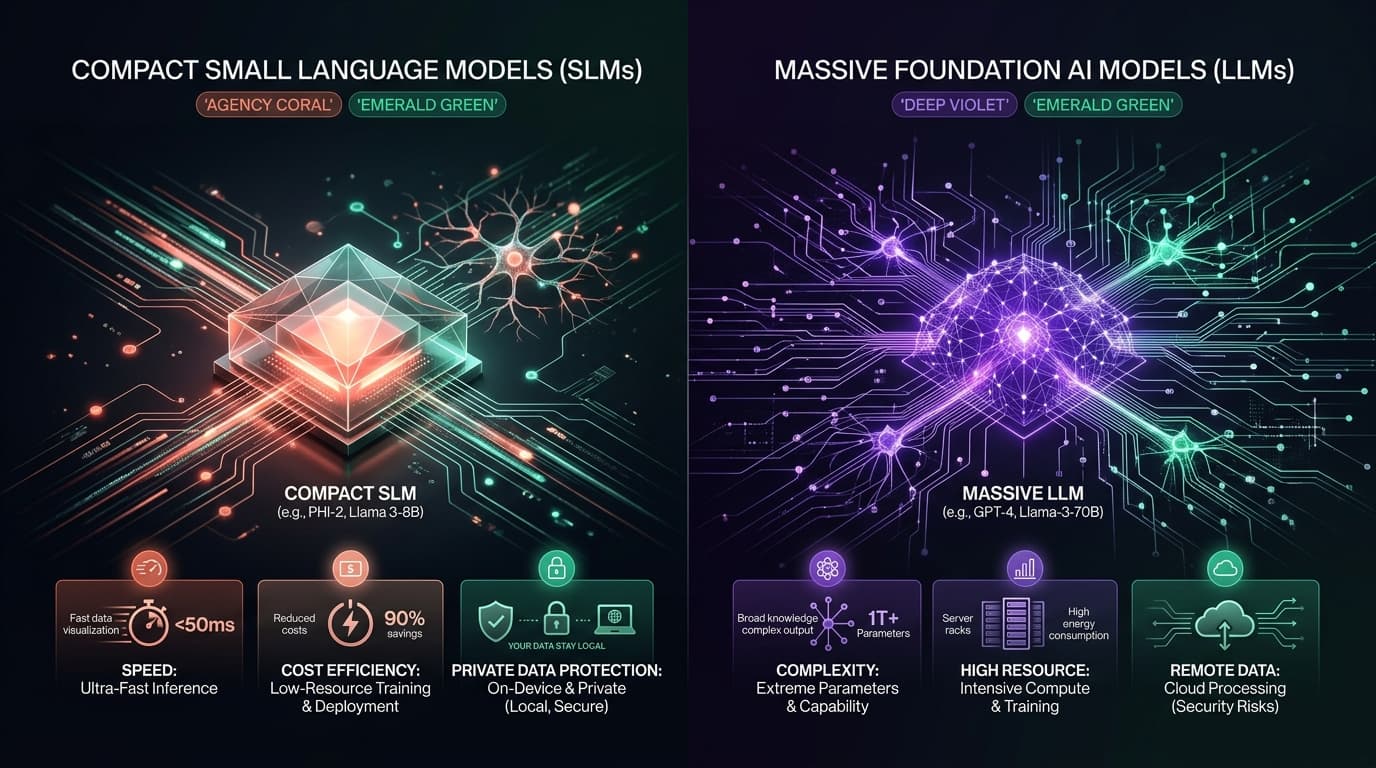
Small AI Models vs Big AI Models: How to Pick the Right Tool, Cut Costs, and Protect Privacy
Master the strategic decision framework between Small Language Models (SLMs) and Frontier Large Language Models (LLMs). Learn how modern engineering teams use intelligent model routing, on-premise local hosting, and targeted LoRA fine-tuning to slash inference costs by 80%, achieve sub-200ms response times, and guarantee 100% data privacy.

Website Development & Search Visibility
Growing Your Organic Traffic: How to Build Helpful, High-Ranking Pages at Scale
Master the modern engineering framework for scaling organic search traffic. Learn how to combine Next.js 15, programmatic SEO, semantic topic authority, and AI search optimization (GEO) to build hundreds of helpful, high-ranking pages that attract qualified buyers.