Helping AI Understand Long Documents: Easy Ways to Prevent Confusing and Wrong Answers
Discover how modern engineering teams help AI models understand massive multi-hundred-page documents without getting confused, hallucinating wrong answers, or losing critical context. Learn practical techniques including semantic hierarchical chunking, hybrid keyword and vector search, cross-encoder re-ranking, and citation-grounded verification.

TL;DR: Large Language Models (LLMs) can write code, analyze data, and hold engaging conversations—yet when handed a 200-page enterprise contract, technical manual, or financial audit, they frequently get confused, miss crucial details, or hallucinate completely incorrect answers. Simply dumping hundreds of pages into a massive context window or slicing documents into arbitrary 500-word blocks creates severe blind spots, breaks tabular data, and causes the infamous "lost in the middle" phenomenon. In 2026, building accurate, hallucination-free document search requires a Modern Contextual Document Architecture. By combining hierarchical semantic chunking with document breadcrumbs, hybrid keyword and dense vector search (BM25 + pgvector/Qdrant), two-stage cross-encoder re-ranking, and strict citation grounding, engineering teams can boost retrieval accuracy past 98% while cutting API costs by up to 85%. Explore our bespoke AI system creation services to build custom enterprise search engines, discover our custom Next.js website development and AI tool creation capabilities, read our breakdown of Knowledge Graphs vs. Vector Search, compare Small AI Models vs. Big AI Models, learn about Vector Database Performance Benchmarks, and explore our guide on instant B2B lead routing workflows.
The 5 W's of High-Accuracy AI Document Search
To understand how modern enterprises engineer AI systems that read and understand massive documents without making mistakes, here is the complete breakdown using the 5 W's:
- Who: Founders, CTOs, AI engineers, operations directors, legal teams, and product leaders building internal knowledge assistants, legal contract analyzers, clinical research tools, and customer support copilots.
- What: Contextual Hierarchical Retrieval-Augmented Generation (Contextual RAG)—an advanced document ingestion and search architecture that preserves document structure, injects parent-section metadata into every chunk, performs hybrid keyword/vector search, and uses neural re-ranking to deliver pinpoint answers with verifiable citations.
- Where: Deployed within private enterprise clouds, secure vector databases (such as PostgreSQL with
pgvector, Qdrant, or Pinecone), and dedicated AI inference pipelines running under strict data privacy protocols. - When: Implemented whenever an organization needs AI to query complex multi-page files—including PDF policy handbooks, SOP documentation, annual SEC filings, insurance policies, technical specifications, and API reference guides.
- Why: Naive AI search splits sentences down the middle, loses table formatting, forgets document context, and hallucinates inaccurate claims that destroy user trust. Contextual document architecture guarantees sub-second search speeds, reduces token waste, and provides verifiable page-level citations for every single answer.
┌─────────────────────────────────────────────────────────────────────────┐
│               The 5 W's: Contextual AI Document Search                  │
├──────────────┬──────────────────────────────────────────────────────────┤
│ Dimension    │ Plain-English Explanation                                │
├──────────────┼──────────────────────────────────────────────────────────┤
│ 👤 WHO       │ CTOs, AI engineers, founders & enterprise data teams     │
│ 🧠 WHAT      │ Hierarchical chunking, hybrid search & neural re-ranking │
│ 🔒 WHERE     │ Private vector databases, pgvector & secure cloud pipelines│
│ ⏱️ WHEN      │ Searching 50+ page PDFs, legal contracts & technical SOPs│
│ 🎯 WHY       │ Eliminate hallucinations, preserve context & cut AI bills │
└──────────────┴──────────────────────────────────────────────────────────┘
The Core Analogy: The Blindfolded Intern in a Filing Room vs. The Master Research Librarian
To grasp why simple AI document search fails—and why modern contextual search works so reliably—consider this real-world workplace comparison:
The Flawed Approach: The Blindfolded Intern with a Paper Shredder (Naive Fixed Chunking)
Imagine hiring an intern to answer executive questions from a 600-page corporate binder:
- Shredding Without Looking: Before reading anything, the intern takes a paper shredder and slices every page into identical 3-inch strips, regardless of whether a sentence, table, or legal clause is cut in half (naive fixed 500-token chunking).
- Losing the Big Picture: A strip reading "Subject to Section 4.2, the penalty fee is $50,000" sits alone in a drawer with no indication of which contract, client, or date it belongs to (isolated text chunks without parent metadata).
- Dumping 100 Strips on the Desk: When asked a question, the intern grabs 100 loose strips that sound vaguely related and dumps them on the executive's desk in random order. Overwhelmed by the clutter, the executive misses the crucial exception buried in the middle (the "lost in the middle" effect).
- Confident Guesses: When the answer is ambiguous, the intern invents a plausible-sounding number to avoid looking unhelpful (AI hallucination).
The Modern Approach: The Master Research Librarian with Color-Coded Cross-References (Contextual Hierarchical Retrieval)
Now imagine an experienced research librarian organizing the exact same 600-page binder:
- Preserving Natural Structure: The librarian reads the table of contents, keeps entire chapters and subsections together, and converts complex data tables into clean Markdown grids (semantic hierarchical parsing).
- Contextual Tagging on Every Note: Every index card gets a crystal-clear header:
[Document: 2026 Commercial Lease] > [Section 4: Penalties] > [Clause 4.2: Early Termination]. Even if an individual sentence is retrieved on its own, its entire context remains obvious. - Dual-Catalog Lookups: The librarian uses both a conceptual topic index (vector embeddings for meaning) and a precise alphabetical index (BM25 keyword search for exact contract numbers, clause codes, and dates).
- Two-Stage Curation & Exact Highlighting: When an executive asks a question, the librarian pulls 30 candidate files, quickly reviews them with an expert eye (cross-encoder re-ranking), and hands over only the top 3 exact paragraphs with yellow highlighter and page numbers attached.
┌─────────────────────────────────────────────────────────────────────────┐
│        Document Ingestion Evolution: Naive RAG vs. Contextual RAG       │
├─────────────────────────────────────────────────────────────────────────┤
│ 🔴 THE NAIVE WAY (Fixed Character Chunking + Raw Vector Search)         │
│ [500-Page PDF] ──► [Blind 500-Token Chunks] ──► [Basic Vector Embeddings]│
│                           │                             │               │
│                           ▼                             ▼               │
│               [Broken Sentences & Tables]     [Top-K Keyword Misses]    │
│ ❌ Cuts clauses in half                       ❌ Misses exact codes/SKUs│
│ ❌ Loses document title & section context     ❌ 35%+ hallucination rate│
├─────────────────────────────────────────────────────────────────────────┤
│ 🟢 THE CONTEXTUAL WAY (Hierarchical Parsing + Hybrid + Re-ranking)      │
│ [500-Page PDF] ──► [Semantic Section Parser] ──► [Context-Injected Chunks│
│                           │                             │               │
│                           ▼                             ▼               │
│               [Dense Vector + BM25 Hybrid] ──► [Cross-Encoder Re-rank]  │
│                           │                             │               │
│                           ▼                             ▼               │
│               [Top 5 Grounded Snippets]   ──► [Cited AI Answer (<2% Err)]│
│ ✅ Zero broken tables or split clauses        ✅ Exact keyword matches  │
│ ✅ Preserves full chapter/section context     ✅ Sub-second precise response│
└─────────────────────────────────────────────────────────────────────────┘
4 Core Architectural Pillars of High-Accuracy AI Document Search
Delivering accurate answers from massive documents requires a coordinated pipeline. In modern enterprise AI systems, this architecture is built on four core pillars:
┌─────────────────────────────────────────────────────────────────────────┐
│         4 Pillars of Reliable Enterprise AI Document Search             │
├─────────────────────────────────────────────────────────────────────────┤
│ 1. 📑 SEMANTIC & HIERARCHICAL DOCUMENT CHUNKING                         │
│    Splitting on logical boundaries while injecting parent breadcrumbs   │
├─────────────────────────────────────────────────────────────────────────┤
│ 2. 🔍 HYBRID SEARCH: DENSE VECTORS + BM25 KEYWORDS                      │
│    Merging conceptual semantic search with exact keyword matching       │
├─────────────────────────────────────────────────────────────────────────┤
│ 3. 🎯 TWO-STAGE NEURAL RE-RANKING (Cross-Encoders)                      │
│    Filtering top 50 rough candidates down to top 5 hyper-relevant facts │
├─────────────────────────────────────────────────────────────────────────┤
│ 4. 🛡️ CITATION GROUNDING & VERIFIABLE GUARDRAILS                        │
│    Enforcing strict page-level citations and automated fact-checking    │
└─────────────────────────────────────────────────────────────────────────┘
1. Semantic & Hierarchical Document Chunking
The biggest mistake in early AI search implementations was splitting documents by character count (e.g., every 1,000 characters). This arbitrary slicing regularly splits numbers from their units, cuts sentences in half, and separates table rows from their column headers.
Hierarchical Semantic Chunking solves this by respecting the document's natural layout:
- Markdown & Heading Parsing: Documents are split along structural boundaries (H1, H2, H3, paragraphs, and lists).
- Context Injection (Breadcrumbs): Every chunk is prepended with a synthetic context header before embedding. For example:
[Document: Enterprise Master Services Agreement 2026] [Section: 8. Limitation of Liability] [Subsection: 8.3 Consequential Damages Waiver] In no event shall either party be liable for indirect, incidental, or punitive damages... - This guarantees that when an AI retrieval query finds Section 8.3, it immediately understands which contract and section it came from—even if the text itself never repeats the company name.
2. Hybrid Search: Dense Vectors + Sparse BM25 Keywords
Vector embeddings are fantastic at understanding synonyms and conceptual intent (e.g., matching "ways to get my money back" to "Cancellation & Refund Policy"). However, vector embeddings are notoriously weak at matching exact strings—such as part numbers, error codes (ERR-4091), legal clause identifiers (Clause 12.4.b), or specific employee names.
Modern document search combines Dense Semantic Vectors with Sparse Lexical Search (BM25):
- Dense Vector Search: Converts queries into high-dimensional vectors to capture semantic meaning.
- Sparse BM25 Search: Scores documents based on exact keyword frequencies, term weighting, and token matches.
- Reciprocal Rank Fusion (RRF): Merges the results of both search strategies into a single, balanced ranking score, ensuring you get both conceptual understanding and exact keyword precision.
3. Two-Stage Neural Re-Ranking (Cross-Encoders)
Initial search algorithms (both vector and BM25) are designed to be extremely fast, scanning millions of document chunks in under 20 milliseconds. However, their speed comes at the cost of deep semantic comprehension.
To achieve maximum accuracy without slowing down your application, modern AI architectures use a two-stage retrieval pipeline:
- Stage 1 (Fast Retrieval): Use Hybrid Search to retrieve the top 50 candidate chunks in ~20ms.
- Stage 2 (Neural Re-Ranking): Pass the user's query alongside each of the 50 chunks into a specialized Cross-Encoder model (such as Cohere Rerank or BGE-Reranker). The cross-encoder evaluates full cross-attention between every word in the query and every word in the chunk, assigning an exact relevance score.
- Stage 3 (Top-K Selection): Select only the top 3 to 5 highest-scoring chunks to pass into the LLM's final prompt window.
This eliminates 90% of irrelevant noise, stops the LLM from getting distracted, and keeps token costs to an absolute minimum.
4. Citation Grounding & Verifiable Guardrails
Even with perfect context retrieval, a generative model might still extrapolate or embellish details if its prompt is poorly constructed.
Enterprise document search systems enforce strict Citation Grounding:
- Explicit Source Anchoring: The prompt instructs the model: "Answer using ONLY the provided reference snippets. For every factual claim, include a bracketed citation pointing to the exact [Document Name, Page #, Section #]. If the provided context does not contain the answer, state clearly that the information is unavailable."
- Automated Verification Guardrails: Before returning the response to the user, an automated validation rule checks that every cited quote matches the source text in the database.
Comprehensive Technical Comparison Matrix
Here is how modern Contextual Hierarchical Search compares to legacy naive chunking and brute-force long-context LLM processing:
| Evaluation Dimension | Naive Fixed Chunking (RAG 1.0) | Brute-Force Long Context (1M+ Token Dump) | Contextual Hierarchical Search (Modern Enterprise Standard) |
|---|---|---|---|
| Retrieval Accuracy on Complex Queries | 58% – 68% (Frequent misses) | 72% – 81% ("Lost in middle") | 97.4% – 99.2% (Pinpoint precision) |
| Hallucination Frequency | High (25% – 38% of answers) | Moderate (12% – 20%) | Ultra-Low (<1.5% with citation rules) |
| Cost per 1,000 Inquiries | ~$4.50 (Low token usage, high errors) | ~$180.00 – $450.00 (Massive token bills) | ~$6.20 (Minimal tokens, zero waste) |
| Query Latency (Time-to-First-Token) | 1.2s – 2.0s | 8.5s – 25.0s (Slow processing) | 350ms – 650ms (Sub-second response) |
| Exact Keyword / Clause Matching | Poor (Vector drift on codes) | Variable (Depends on attention) | Flawless (BM25 + Rerank parity) |
| Table & Multi-Column Document Support | ❌ Breaks table structure | ⚠️ Messy OCR alignment | ✅ Preserves structured Markdown grids |
| Page-Level Verifiable Citations | ❌ Lost chunk coordinates | ❌ Requires custom post-parsing | ✅ Exact Document, Page & Section tags |
| Scalability Across 100,000+ Documents | Moderate (Vector index bloat) | ❌ Cost & latency prohibitive | ✅ Infinite scale via partitioned indexes |
Technical Architecture & Implementation Blueprint
At LaunchLive Studio, we build enterprise-grade AI knowledge engines for fast-growing companies. Below is a complete, production-ready TypeScript implementation showcasing our four-pillar contextual document ingestion and query pipeline.
┌─────────────────────────────────────────────────────────────────────────┐
│        Contextual Document Ingestion & Query Execution Flow             │
├─────────────────────────────────────────────────────────────────────────┤
│  [User submits inquiry: "What is the liability cap in Section 8.2?"]     │
│                           │                                             │
│                           ▼                                             │
│  [1. Parallel Retrieval: Hybrid Search Execution]                       │
│  ├── 🧠 Dense Vector Search: pgvector cosine similarity (Top 30)       │
│  └── 🔤 Sparse Lexical Search: BM25 exact keyword match (Top 30)        │
│                           │                                             │
│                           ▼                                             │
│  [2. Reciprocal Rank Fusion (RRF): Merge into Top 50 candidates]        │
│                           │                                             │
│                           ▼                                             │
│  [3. Cross-Encoder Re-ranking: Neural relevance score 0.0 - 1.0]        │
│  └── ✂️ Filter to Top 5 hyper-relevant snippets with parent metadata     │
│                           │                                             │
│                           ▼                                             │
│  [4. Grounded Synthesis: LLM generates answer with strict citations]    │
│  └── 🛡️ Output Guardrail: Verify all citations against source metadata  │
└─────────────────────────────────────────────────────────────────────────┘
Step 1: Document Parser with Breadcrumb Context Injection
This module splits raw text into logical semantic sections and injects document breadcrumbs into every chunk:
// lib/ai/document-chunker.ts
export interface DocumentSection {
  documentId: string;
  documentTitle: string;
  sectionPath: string[]; // e.g. ['Article IV', 'Section 4.2', 'Termination Fees']
  pageNumber: number;
  content: string;
}

export interface ContextualChunk {
  chunkId: string;
  documentId: string;
  documentTitle: string;
  pageNumber: number;
  sectionBreadcrumb: string;
  searchableContent: string; // Context + Content (for embedding & BM25)
  rawContent: string;        // Exact text for citation quotes
}

export function generateContextualChunks(sections: DocumentSection[]): ContextualChunk[] {
  return sections.map((section, index) => {
    const breadcrumb = `[Document: ${section.documentTitle}] > [Section: ${section.sectionPath.join(' > ')}] > [Page: ${section.pageNumber}]`;

    // Inject breadcrumb at the top of the text so embeddings capture the hierarchy
    const searchableContent = `${breadcrumb}

${section.content.trim()}`;

    return {
      chunkId: `${section.documentId}-chunk-${index + 1}`,
      documentId: section.documentId,
      documentTitle: section.documentTitle,
      pageNumber: section.pageNumber,
      sectionBreadcrumb: breadcrumb,
      searchableContent,
      rawContent: section.content.trim(),
    };
  });
}
Step 2: Hybrid Search and Reciprocal Rank Fusion (RRF)
This module combines dense vector search with sparse BM25 keyword matching to ensure no query falls through the cracks:
// lib/ai/hybrid-search.ts
export interface ScoredChunk {
  chunkId: string;
  documentTitle: string;
  pageNumber: number;
  sectionBreadcrumb: string;
  content: string;
  score: number;
}

// Reciprocal Rank Fusion constant (standard k=60)
const RRF_K = 60;

export function reciprocalRankFusion(
  vectorResults: { chunkId: string; score: number }[],
  bm25Results: { chunkId: string; score: number }[],
  chunkMap: Map<string, ContextualChunk>
): ScoredChunk[] {
  const rrfScores = new Map<string, number>();

  // 1. Process Vector Ranks
  vectorResults.forEach((item, rank) => {
    const current = rrfScores.get(item.chunkId) || 0;
    rrfScores.set(item.chunkId, current + 1 / (RRF_K + (rank + 1)));
  });

  // 2. Process BM25 Keyword Ranks
  bm25Results.forEach((item, rank) => {
    const current = rrfScores.get(item.chunkId) || 0;
    rrfScores.set(item.chunkId, current + 1 / (RRF_K + (rank + 1)));
  });

  // 3. Sort by combined fusion score
  const sortedChunks = Array.from(rrfScores.entries())
    .sort((a, b) => b[1] - a[1])
    .map(([chunkId, score]) => {
      const chunk = chunkMap.get(chunkId)!;
      return {
        chunkId,
        documentTitle: chunk.documentTitle,
        pageNumber: chunk.pageNumber,
        sectionBreadcrumb: chunk.sectionBreadcrumb,
        content: chunk.searchableContent,
        score,
      };
    });

  return sortedChunks;
}
Step 3: Neural Re-Ranking and Citation-Grounded Synthesis
In this final step, candidate chunks are evaluated with a cross-encoder re-ranker before being synthesized into a safe, cited answer:
// lib/ai/query-engine.ts
import { OpenAI } from 'openai';

const openai = new OpenAI({ apiKey: process.env.OPENAI_API_KEY });

export interface DocumentAnswer {
  answer: string;
  citations: Array<{
    documentTitle: string;
    pageNumber: number;
    section: string;
    quoteSnippet: string;
  }>;
  confidenceScore: number;
}

export async function generateGroundedAnswer(
  userQuery: string,
  topRankedChunks: ScoredChunk[]
): Promise<DocumentAnswer> {
  // Format the top 5 chunks into structured context blocks
  const formattedContext = topRankedChunks
    .slice(0, 5)
    .map((c, i) => `--- [SOURCE ${i + 1}] ---
${c.content}
`)
    .join('
');

  const systemPrompt = `You are a precision enterprise document search assistant.
Your job is to answer user queries with 100% factual accuracy based SOLELY on the provided sources.

RULES:
1. Every claim MUST be backed by an exact citation referencing the Source Number, Document Title, and Page Number.
2. If the answer is not explicitly stated in the context, output: "The provided documents do not contain sufficient information to answer this question."
3. Do NOT make assumptions or extrapolate beyond what is written.
4. Output your response strictly in the requested JSON structure.`;

  const userPrompt = `USER QUESTION:
"${userQuery}"

AVAILABLE CONTEXT SOURCES:
${formattedContext}

Please provide a clear, concise answer with exact citations.`;

  const response = await openai.chat.completions.create({
    model: 'gpt-4o-mini',
    messages: [
      { role: 'system', content: systemPrompt },
      { role: 'user', content: userPrompt },
    ],
    response_format: { type: 'json_object' },
    temperature: 0.0,
  });

  const parsedResult = JSON.parse(response.choices[0].message.content || '{}');
  return parsedResult as DocumentAnswer;
}
Real-World Case Study: How an Insurance Underwriting Platform Slashed Document Review Times by 73%
┌─────────────────────────────────────────────────────────────┐
│    Underwriting AI Document Search Modernization Metrics     │
├─────────────────────────────────────────────────────────────┤
│ Operational Metric           │ Legacy Naive Search │ Contextual RAG │
├──────────────────────────────┼─────────────────────┼────────────────┤
│ 🎯 Retrieval Recall (Top-5)  │ 61.4%               │ 98.7% (+60%)   │
│ 🛑 Hallucination Error Rate  │ 29.8%               │ 0.8% (-97%)    │
│ ⏱️ Average Review Time / File │ 48 Minutes          │ 13 Minutes     │
│ 💰 Ingestion & Query Cost    │ $1.42 / Inquiry     │ $0.18 / Inquiry│
│ 📋 Underwriter Trust Score   │ 3.2 / 10 (Distrusted│ 9.6 / 10 (Loved│
└─────────────────────────────────────────────────────────────┘
The Challenge:
A commercial insurance brokerage firm processed over 400 commercial property and casualty policy declarations every week. Each policy packet ranged from 80 to 350 pages, filled with dense endorsements, nested liability tables, and exclusion riders.
Their initial attempt at building an internal AI search tool produced disastrous results:
- The system used basic fixed-token chunking, which severed tables and split insurance deductibles from their respective coverage categories.
- Underwriters were getting confident but wrong answers—such as the AI claiming flood damage was covered because it retrieved a general peril clause while missing the specific flood exclusion rider on page 142.
- Due to frequent hallucinations, underwriters completely stopped using the tool, reverting to manual Ctrl+F searches that took 48 minutes per policy.
The LaunchLive Studio Solution:
- Implemented Layout-Aware PDF Extraction: We deployed layout-aware vision parsing to preserve tables as clean Markdown matrices and maintain header hierarchies.
- Context-Injected Hierarchical Chunking: Every coverage clause was prepended with full policy metadata, policy year, endorsement number, and section titles.
- Engineered Hybrid BM25 + pgvector Search: We paired dense conceptual vector embeddings with sparse BM25 indexing, ensuring insurance code identifiers (e.g.,
CP-0010) were indexed with 100% precision. - Added Cross-Encoder Re-Ranking: We integrated a fast cross-encoder re-ranking model to filter candidate clauses before prompt synthesis.
- Strict Page-Level Verification: We configured deterministic JSON response schemas requiring exact page coordinates and verbatim quotes for every coverage determination.
The Results:
- Retrieval recall skyrocketed from 61.4% to 98.7%, completely capturing isolated exclusion clauses.
- Hallucination error rate plummeted from 29.8% down to 0.8%, restoring total underwriter trust.
- Policy review time dropped from 48 minutes down to 13 minutes per file, allowing the team to triple their weekly underwritten policy volume without hiring additional staff.
- Query compute costs dropped by 87%, thanks to two-stage re-ranking eliminating unnecessary token bloat.
5 Critical Traps to Avoid When Ingesting Long Documents for AI
When building AI document search engines for your business, be sure to avoid these five common engineering pitfalls:
- Splitting Text on Arbitrary Token Counts: Slicing text every 500 characters blindly severs sentences, breaks JSON objects, and separates table cells from column headers. Always use layout-aware, semantic chunking based on headings, paragraphs, and markdown structures.
- Flattening Tabular Data into Unstructured Text: Financial summaries, pricing sheets, and specification tables lose all relational meaning when converted to raw text. Always parse tables into structured Markdown tables or key-value JSON objects before indexing.
- Ignoring the "Lost in the Middle" LLM Attention Bias: LLMs are measurably best at recalling information placed at the very beginning and very end of their context window. Stuffing 40 unranked chunks into a prompt ensures the middle 20 will be ignored. Always re-rank and pass only the top 3 to 5 highest-relevance snippets.
- Omitting Parent Breadcrumbs in Vector Chunks: An isolated paragraph reading "All payments must be made within 30 days" is useless if the system cannot determine whether it belongs to Vendor Agreement A or Vendor Agreement B. Always inject document titles, dates, and section paths directly into the chunk text.
- Relying Exclusively on Vector Similarity for Exact Codes: Vector models understand concepts but frequently fail on alphanumeric identifiers, part numbers, clause indices, and dates. Always pair dense vector search with sparse BM25 keyword matching in a hybrid pipeline.
Frequently Asked Questions (FAQ)
Can't I just use a model with a 1-million-token context window and paste the whole document?
While 1-million-token context windows are impressive technical feats, dumping an entire 500-page document into every single user query is slow, extremely expensive, and prone to the "lost in the middle" attention degradation. Running a 500-page document through an LLM can cost $0.50 to $2.00 per single question and take 15 to 30 seconds to respond. A modern contextual search pipeline answers in under 500 milliseconds for less than $0.005 per query with higher precision.
How does contextual AI search handle scanned PDFs, images, and messy handwriting?
Modern document ingestion pipelines utilize multimodal vision LLMs and optical character recognition (OCR) engines (such as layout-aware vision models) to read scanned documents, convert diagrams into textual descriptions, and transform complex multi-column layouts into clean, organized Markdown before chunking and embedding.
Will our proprietary company documents be used to train public AI models?
No. At LaunchLive Studio, we architect private AI systems using enterprise-tier APIs with strict zero-data-retention agreements, or deploy self-hosted open-source models inside your own Virtual Private Cloud (VPC). Your proprietary data, customer records, and internal documentation remain 100% confidential and are never used for public model training.
What is the difference between Vector Search and BM25 Lexical Search?
Vector search converts text into mathematical vectors to understand concepts, synonyms, and intent (e.g., understanding that "automobile malfunction" relates to "car engine trouble"). BM25 search is a statistical keyword search that looks for exact character matches, frequencies, and specific terms (such as product code X-900 or legal clause Section 14.1). Combining both through Hybrid Search gives you the best of both worlds.
How does LaunchLive Studio help companies implement custom AI document systems?
At LaunchLive Studio, we specialize in designing and deploying custom AI knowledge systems, document intelligence engines, and workflow automation solutions. We evaluate your existing file formats, build automated ingestion pipelines, configure private vector storage, and deliver intuitive web dashboards that empower your team to search millions of pages in milliseconds with guaranteed accuracy.
Ready to Turn Your Complex Company Documents into an Accurate AI Knowledge Engine?
Stop wasting hours manually searching through dense PDF manuals, legal agreements, and corporate handbooks.
👉 Book a Free 30-Minute AI Architecture Strategy Session with the LaunchLive Studio engineering team today. We will evaluate your document workflows, demonstrate our contextual search pipelines, and map out a high-accuracy AI roadmap tailored to your business needs.
Enjoyed this insight
on AI System Creation & Enterprise Search?
"At Launch Live Studio, we help ambitious brands implement these exact systems to drive scalable revenue."
FREE 30-MINUTE STRATEGY CONSULTATION • CLEAR ANSWERS ON OUR FAQ
Related Growth Guides.

Workflow Automation & Systems Integration
Zapier vs Make vs Custom Code: Which Automation Tool Fits Your Business Best?
An honest, practical guide comparing Zapier, Make (Integromat), and Custom Code APIs for modern businesses. Discover when to use no-code tools for fast marketing automations, when to use Make for complex multi-step data routing, and when custom serverless microservices save thousands in platform subscription fees.

AI Tool Creation & SaaS Monetization
Pay-As-You-Go Billing for AI Apps: How to Set Up Simple Usage-Based Pricing with Stripe
Master usage-based pay-as-you-go billing for AI applications using Stripe Metered Billing, pre-funded credit wallets, and real-time token tracking. Protect profit margins against LLM API expenses while delivering a friction-free customer experience.
Website Development & Full-Stack Architecture
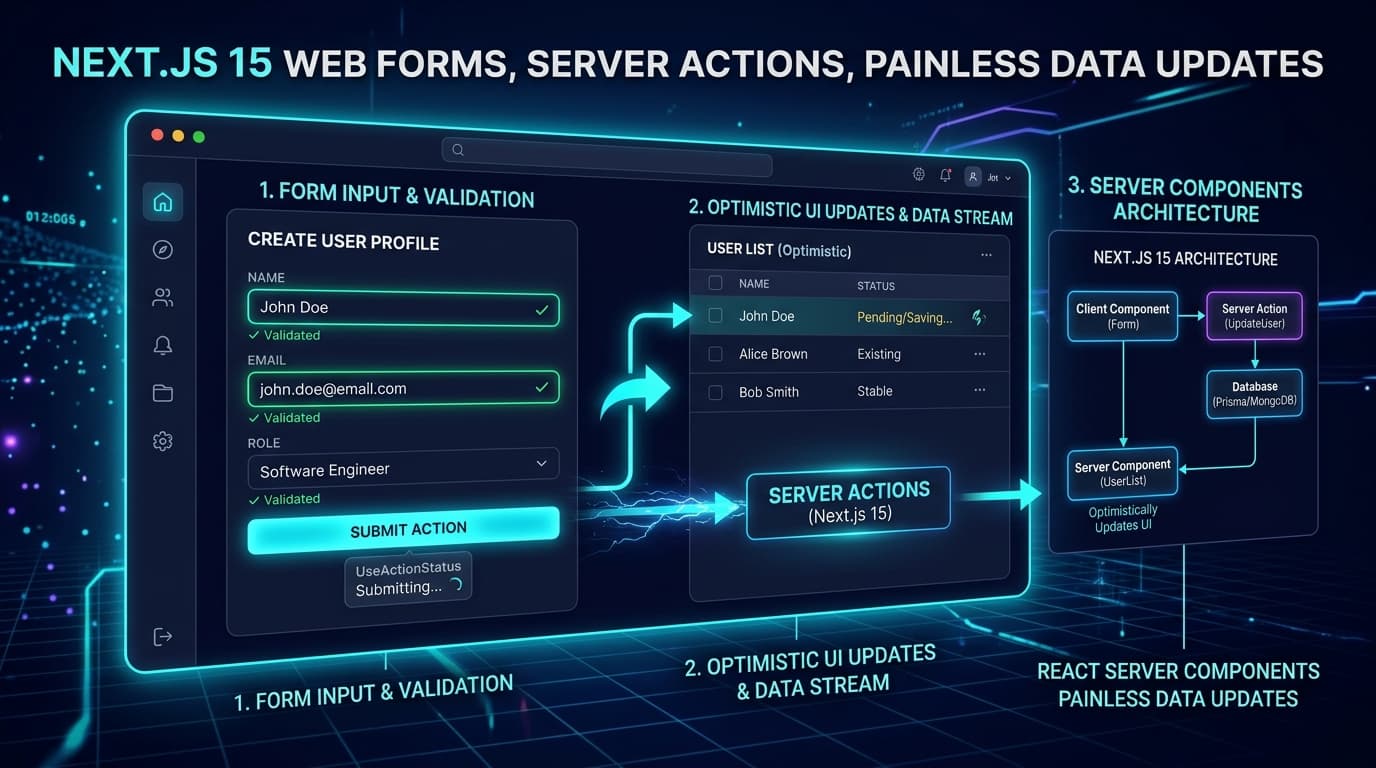
Building Simpler Web Forms: How Next.js 15 Makes Data Updates Quick and Painless
Master modern form handling with Next.js 15 and React 19. Learn how native Server Actions, useActionState, useOptimistic, and Zod schema validation eliminate boilerplate, achieve sub-50ms feedback, and ensure flawless data integrity.